logo

Harbingers’ Magazine is a weekly online current affairs magazine written and edited by teenagers worldwide.

harbinger | noun

har·​bin·​ger | \ˈhär-bən-jər\

1. one that initiates a major change: a person or thing that originates or helps open up a new activity, method, or technology; pioneer.

2. something that foreshadows a future event : something that gives an anticipatory sign of what is to come.

cookie_image

We and our partners may store and access personal data such as cookies, device identifiers or other similar technologies on your device and process such data to personalise content and ads, provide social media features and analyse our traffic.

13 February 2026

Europe’s nuclear deterrence in focus at Munich Security Conference

author_bio
Irma Mecele in Munich, Germany

Article link copied.

slide image

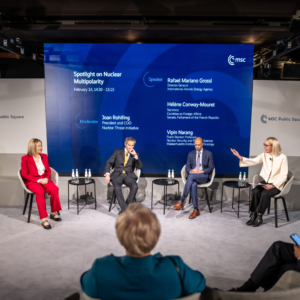
'Nuclear Multipolarity' panel discussion at the MSC 2025.

Picture by: Munich Security Conference

Europe risks facing a “dangerous deterrence gap” unless it urgently rethinks its nuclear options, according to a major new report released ahead of the Munich Security Conference 2026, taking place on 13–15 February.

The report, entitled Mind the Deterrence Gap: Assessing Europe’s Nuclear Options, was prepared by the European Nuclear Study Group and is being presented to policymakers and defence experts gathered in Munich.

Writing from Munich before the conference kicks off, Harbingers’ highlights the report’s warning that the global nuclear order is shifting.

The study argues that repeated nuclear threats from Moscow, combined with growing doubts in some European capitals about the long-term reliability of US security guarantees, are forcing Europe to confront a strategic question it has long avoided.

“Europeans can no longer outsource their thinking about nuclear deterrence to the United States,” the report states. “The era in which Europe could afford strategic complacency has ended.”

Five options under discussion

The report’s authors, a multinational team of defence and security experts, assess five options currently circulating in the political debate.

These are: continued reliance on US extended nuclear deterrence; strengthening the role of British and French nuclear forces in European deterrence; developing a common European deterrent; pursuing new, independent national nuclear deterrents; and investing in conventional deterrence without a nuclear component.

The authors stop short of endorsing any single option. Instead, they stress that each path involves significant political, financial and strategic trade-offs.

“There is no good option for Europe to assure deterrence with less US support,” the report concludes. But ignoring the issue, it warns, could leave Europe dangerously exposed in a rapidly deteriorating security environment.

Increasingly urgent debate

For decades, nuclear policy has remained a politically sensitive topic across much of Europe. The study group argues that discussion about nuclear policy is now unavoidable.

“However uncomfortable the debate may be, the new security environment requires European policymakers to confront the role of nuclear weapons in the defence of the continent directly and without delay,” the authors write.

The European Nuclear Study Group, established in 2024, is a joint initiative of the Munich Security Conference, the Centre for International Security at the Hertie School in Berlin, and the Institute of Political Science at the University of St Gallen, Switzerland.

The group focuses on strategic doctrines, nuclear modernisation and contributes to the widening transatlantic debate on the new nuclear age.

As leaders and experts continue discussions in Munich this weekend, this report adds urgency to questions that could shape Europe’s security framework for years to come.

Written by:

author_bio

Irma Mecele

International Affairs Section Editor 2026

Vilnius, Lithuania

Irma Mecele, born in 2009 in London, joined Harbingers’ Magazine in August 2025 as part of the Japan Newsroom programme. Since then, she has written regularly for the magazine, covering politics, international affairs and society. Her work quickly established her as a thoughtful reporter and earned her the role of International Affairs Correspondent in January 2026.

In February the same year, Irma reported on the ground from the Munich Security Conference, becoming one of the world’s youngest journalists to cover the event in person. She produced a series of multimedia pieces combining interviews, research and her own reporting from the conference.

Her consistent work and engagement with the magazine led to her appointment as International Affairs Section Editor for 2026, a role she took up on 1 March.

Irma is interested in history, politics and the environment, and plans to study economics. She has completed a Columbia University programme, undertaken an internship at the European Union, and participated in The Voice Kids of Spain.

In her free time, Irma plays tennis and piano, practises karate and boxing, and enjoys learning languages, travelling and singing. She speaks Russian, English and Spanish, and studies French and Lithuanian.

politics

🌍 Join the World's Youngest Newsroom—Create a Free Account

Sign up to save your favourite articles, get personalised recommendations, and stay informed about stories that Gen Z worldwide actually care about. Plus, subscribe to our newsletter for the latest stories delivered straight to your inbox. 📲

Login/Register