


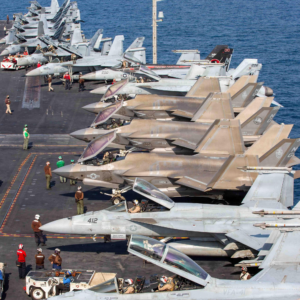
Arnav, 17, explains how military spending has surged worldwide and the politics behind it
Armed conflict and military tension remain a defining feature of the international landscape. At time of writing, the United States and Israel are engaged in direct conflict with Iran, following a 28 February strike that killed Iran’s supreme leader Ayatolleh Ali Khamenei and triggered a regional war.
In Europe, Russia’s war in Ukraine has entered its fourth year, with sustained fighting and no comprehensive settlement in sight. Across Asia, military exchanges (Israel–Iran and India–Pakistan) pushed regional tensions to the brink in 2025, though a ceasefire (of sorts) was eventually brokered in Gaza.
Against this backdrop, military spending has surged. It soared past $2.7tn in 2024, a 9.4% jump from 2023. Europe and the Middle East saw the fastest growth, while five countries (US, China, Russia, Germany, India) made up more than 60% of global expenditure.
Harbingers’ Weekly Brief
Subscribe to the Harbingers’ Weekly Brief, a newsletter written by the editorial board of Harbingers’ Magazine, the world’s youngest newsroom, delivered to your inbox every Monday morning.
![slide image]()
![author_bio]()
![author_bio]()


In an ever more polarised world – where ideological rifts grow and geopolitical tension takes centre stage – what kind of future are we creating when investment in conflict so often outweighs efforts to avoid it?
How countries are buying power
In 2024, the European Union spent more than €343bn ($399bn) on defence – the highest collective military expenditure in its history. For 2025, that figure rose to a projected €381bn ($443bn) to accommodate long-term procurement goals.
Predictably, this trend extends well beyond Europe. Across the Indo-Pacific, defence postures have shifted rapidly – driven above all by China’s military expansion. While Beijing’s official defence budget for 2025 reached nearly $247bn, the actual figure is estimated to be significantly higher, creating a regional “gravity well” that forces neighbours and competitors to reassess defence strategies in response to China’s growing reach.
In response, countries aligned with the QUAD – a strategic grouping of India, Japan, the United States and Australia, focused on Indo-Pacific security – have accelerated their own procurement. The alliance, increasingly seen as a counterweight to China’s aggressive regional posture, has become a key driver of coordinated military planning.
In 2025, this translated into concrete action:
- India scaled up its own naval production and long-range missile acquisitions.
- Japan expanded its strike capabilities despite limitations following the Second World War.
- Australia deepened submarine investment under the AUKUS (Australia, United Kingdom, United States) framework.
- The United States placed greater emphasis on its Indo-Pacific operations.
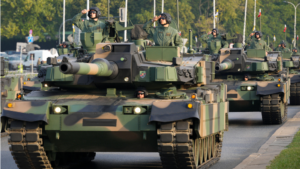
Across Eurasia, spending on equipment and research and development has boomed. Poland is actively building what it hopes will be Europe’s largest land army, expanding towards 300,000 active personnel with military expenditure accounting for nearly 5% of GDP. It has placed massive orders for American and South Korean equipment, including K2 tanks and Apache helicopters.
South Korea has also increased its defence budget by 7.5%, driven by the escalating North Korean threat and its ambition to become one of the most aggressive military exporters in the world.
In 2025, Ukraine’s wartime economy pivoted towards self-reliance, dedicating more than 26% of its $210bn GDP to defence while investing over $10bn to increase domestic arms production. Facing the prospect of a long-term conflict, Kyiv is aggressively expanding its own manufacturing of drones and missiles to reduce its dependence on Western shipments and aid packages.
Notably, smaller countries such as Finland have ramped up military investment. Newly admitted to NATO and sharing a 1,340-kilometre border with Russia, Finland increased its defence budget for 2026 to 2.5% of GDP– making it one of NATO’s highest per capita defence spenders.
New threats, new technologies
Modern warfare and strategic deterrence are no longer anchored in traditional measures such as personnel count or air superiority.
Cyberattacks on infrastructure and state systems have blurred the line between espionage and warfare, with global cybercrime costs projected to surpass $12tn annually by 2031. The global response has been uneven but urgent. The US Department of Defense poured more than $15bn into cyber operations for 2026 (the largest such budget in its history), while even small countries such as Estonia are rapidly increasing their national cyber defence units.
Meanwhile, space has become the high ground of 21st-century deterrence. Global government spending on defence-related space systems reached $74bn in 2025, led by large economies with the industrial depth and capital to build and launch satellites at scale.

In addition to the US, Russia and China, which have long led the space race, countriessuch as Japan, India and France have all expanded their military satellite programmes to reduce dependence on foreign providers.
But perhaps no technology has shifted the rules of modern conflict faster than drones. In Ukraine, both sides have deployed low-cost kamikaze drones (some costing under $2,000), often provoking responseswith multimillion-dollar air defence systems. Iran and its proxies have used Shahed dronesin a similar way: they are cheap, disposable and effective at drawing out expensive countermeasures.
Valued at $15.1bn in 2024, the drone market may exceed$47bn by 2032 – and possibly $187bn by 2034 – fuelled by geopolitical instability and tech breakthroughs.
Role of private companies
Beneath this technological arms race lies a quieter transformation: the deep fusion of private industry within national defence. Governments have long relied on industry, but today’s dependence runs deeper – with private firms not only manufacturing weapons, but shaping their design, direction and deployment.
Defence giants such as Lockheed Martin and Boeing in the US and Dassault Aviation in France are leading programmes in fighter aircraft, missile systems and electronic warfare.
In 2025, Lockheed struck a landmark profit-sharing agreement with the Pentagon, expanding on its long-standing role as the US military’s primary supplier of aircraft (such as the F-35 stealth fighter) and missile systems (such as the HIMARS mobile rocket launcher).
The US government also made a rare $1bn equity investment in L3Harris, maker of rocket motors – the first time it has taken direct ownership in a private defence supplier in order to rapidly increase production.
View this post on Instagram
In Europe, France’s Dassault Aviation has partnered with AI startup Harmattan to embed autonomous capabilities into next-generation drones. Separately, India has just agreed to procure another 114 Rafale fighter jets in a mega-deal valued at nearly $36bn coordinated with the French government and Dassault.
Israel, the United Arab Emirates, South Korea and Australia are rapidly building defence tech sectors of their own, seeking not just security and defence advantages but economic leverage. Israel, long a top-tier arms exporter, has deepened its position as a global R&D hub, with more than 330 active firms driving innovation in missile defence, drones and AI-driven warfare.
These partnerships are efficient, but they raise questions. As governments increasingly rely on the private sector to build the next generation of warfare, who sets the priorities? Who owns the intellectual property behind weapons systems that define national security? And what happens when war becomes a growth sector rather than Plan B?
In a world spending trillions to prepare for conflict, it’s no longer clear whether deterrence is the destination – or just the new default.

Edited by:

© 2026 The Oxford School for the Future