


16-year-old Jennifer reveals how the last days of the tournament brought out the best and the worst in players
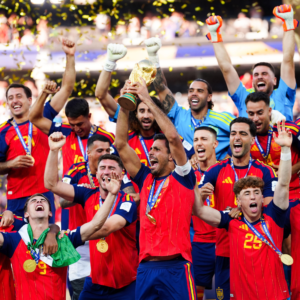
¡España es campeón del mundo! Spain’s victory over Argentina in the final marks the end of the 2026 FIFA World Cup. Spain’s success brings them their second World Cup title, adding a star above their country’s crest.
Through controversies, highs and lows, 48 teams were narrowed down to just four — France, Spain, England and Argentina. In the last week of the tournament, these teams battled each other in thrilling and high-stakes matches, ending in both happiness and heartbreak.
In the semi-final between England and Argentina, the former went ahead at the start of the second half, but then fell into defensive mode. Argentina eventually broke through, scoring twice in quick succession, in the 85th and 92nd minutes, ending millions of England fans’ dream of football coming home.
Harbingers’ Weekly Brief
Subscribe to the Harbingers’ Weekly Brief, a newsletter written by the editorial board of Harbingers’ Magazine, the world’s youngest newsroom, delivered to your inbox every Monday morning.
![author_bio]()


In the second sem-final, tournament favourites France were outclassed by a superb Spain. After a heavy kick from Lucas Digne on Lamine Yamal’s thigh, La Roja were awarded a penalty – and scored. In the second half, Spain’s defence limited France’s attacking chances by retaining possession, blocking passing lanes and slowing them down. They scored again in the 58th minute, winning 2–0.
Below is a recap of the third-place match and the final itself, but first, let’s go through the tournament’s individual awards and achievements.
- The Golden Boot for most goals scored during the tournament went to Kylian Mbappe from France. Mbappe’s two goals from the third-place match cemented his lead ahead of Argentina’s Lionel Messi. He ended the tournament with a whopping ten goals, and also overtook Messi in the World Cup all-time record with 22 goals to his name. The Silver Boot went to Messi (eight goals) and the Bronze Boot to England’s Jude Bellingham (seven).
- The Golden Ball for best overall player was given to Rodri from Spain. He may not have scored a single goal or assist all tournament, but he had more passes, distance covered and involvement than any other player. His key role as a midfielder contributed to Spain’s successful campaign. The Silver Ball went to Messi and the Bronze Ball to Mbappe.
- The Golden Glove for best goalkeeper was awarded to Unai Simon, also from Spain. Despite not having to make a single save in the final against Argentina, Simon was outstanding throughout the tournament, racking up seven clean sheets and only conceding one goal, against Belgium.
- Spain also picked up the the Best Young Player award, for 19-year-old Pau Cubarsí. He emerged from the tournament as one of the best defenders in the world, and his future looks bright.
- FIFA’s Fair Play Award went to the Netherlands. During their time at the tournament, the Dutch side took home only three yellow cards – all in their very first match, against Japan.
View this post on Instagram
Third-place match was one of the best
The “bronze final” between the two losers of the semi-finals, to determine who comes third, is often deemed unnecessary and boring by many fans, but this year’s match proved them wrong. England and France produced one of the best games in the tournament in Miami on 18 July. In a rare ten-goal thriller, England clinched third place by beating France 6–4.
The Three Lions started strongly. After only three minutes, England’s Damien Rice scored his first goal of the tournament to put England ahead. England’s Ezri Konsa followed by scoring a header at 18 minutes and then Bukayo Saka added another two goals. At half time, France’s defence was in shambles and England were leading 4-0.
However, Les Bleus came roaring out from the locker room. Kylian Mbappe scored two goals and Bradley Barcola one to make it 4–3 and give France the chance of a comeback victory. But a foul in the 87th minute won England a penalty that gave Saka a World Cup hat-trick.
Dembele scored a fifth goal for France in stoppage time, but English star Jude Bellingham responded in the 98th minute, destroying France’s chances of victory.
The final: Spain vs. Argentina
The final took place on 19 July in the MetLife Stadium in New Jersey, US. As the starting whistle blew, reigning World Cup champions Argentina looked to defend their title while Spain, winners in 2010, hoped to add a second star to their jersey.
The first 90 minutes of the match remained goalless, with numerous stoppages and a bad-tempered display from Argentina. Spain dominated momentum, with 68% possession and 20 shots on goal, far more than Argentina’s three shots. If it wasn’t for goalkeeper Emi Martinez’s stellar performance, saving 11 shots, Spain would have taken the lead much earlier.
Minutes before extra time began, Argentina’s Enzo Fernandez, who already had a yellow card, was sent off for a reckless and careless tackle on Spain’s Pau Cubarsí. Argentina were left with ten men, handing Spain a massive advantage.

At 97 minutes, Nico Williams thought he had scored for Spain – but the goal was disalloweddue to a foul in the build-up. Just as extra time was about to end, Spain’s Ferran Torres stepped up to be the match hero. At 106 minutes, Torres took the ball from Williams’s header and scoredwith a powerful close-range shot.
The only goal of the match was enough to crown Spain champions – deservedlyso.
The final also introduced the first-ever half-time show,similar to a Super Bowl half-time performance. The show was curated by Coldplay’s Chris Martin and co-headlined by Madonna, BTS and Shakira, with appearances from Justin Bieber, Burna Boy and the Muppets alongside musicians from Venezuela’s Simón Bolívar Symphony Orchestra. Brazilian football stars Ronaldinho and Ronaldo even turned up.
Despite the star-studded line-up, this new addition was heavily criticised. It extended a maximum 15-minute break, as mandated by football’s governing body, to 27 minutes. International observers, in particular, slammed it for being unnecessary and breaking up the flow of the game.
Looking ahead
The countdown to the next tournament begins now. As 2030 marks the 100th anniversary of the FIFA World Cup, it should be pretty special. For the first time in history, the world Cup will be played in six countries.
To honour the first tournament, hosted by Uruguay in 1930, three opening matches will be held in Uruguay, Argentina and Paraguay. The tournament will then move from South America to three host countries: Morocco, Spain and Portugal.

© 2026 The Oxford School for the Future

