


16-year-old interviewed a Nagasaki University Professor on the past and future of nuclear disarmament
As we mark the 80th anniversary of the atomic bombings on Hiroshima and Nagasaki, this moment invites us to reflect on the importance of embracing multiple historical perspectives and the continued advocacy for nuclear non-proliferation.
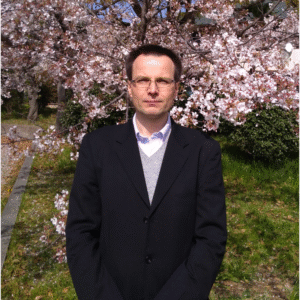
During my time with the Hiroshima and Nagasaki Newsroom, I spoke with Radomir Compel, an Associate Professor of Comparative Politics at the Global School of Humanities and Social Sciences of Nagasaki University. His interest in Japan’s history, culture, values and philosophy led him from Czechia and Slovakia to Nagasaki, a Japanese city shaped by war and peace.
Harbingers’ Weekly Brief
Subscribe to the Harbingers’ Weekly Brief, a newsletter written by the editorial board of Harbingers’ Magazine, the world’s youngest newsroom, delivered to your inbox every Monday morning.
![author_bio]()


The Japanese term hibakusha, central to Hiroshima and Nagasaki’s historical legacy, refers to the survivors of the atomic bombs. Though hibakusha endured the initial blasts, many suffered from long-term illness from radiation, loss of loved ones and discrimination.
Having engaged with cultures from the east to the west, Professor Compel understands how narratives shift depending on cultural viewpoint. In our conversation, we explored the contrast of international and local perspectives of hibakusha.
Internationally, hibakusha are often seen as symbols of resilience – heroic individuals who rose from the ashes of destruction.
Prof Radomir Compel, Nagasaki University
Yet, Professor Compel noted, while some Japanese locals hold the same perspective, many thought differently after World War II.
He went on to explain that the international community often overlooks the marginalisation hibakusha faced long after the bombs fell.
“If hibakusha mentioned that they are from Nagasaki or Hiroshima, people would avoid the subject entirely and turn away.” Due to the lack of public support, hibakusha often internalised their sufferings and stayed silent.
Their silence was not only imposed by society, but also rooted internally. In addition to facing discrimination, the trauma was so intense that it led to cognitive and emotional barriers.
Reflecting on his research into victims of both the atomic bombings of Nagasaki and the Battle of Okinawa, Professor Compel explained that many stayed silent because “they are processing and trying to settle on their experiences – it’s a kind of mental process.”
Professor Compel’s insights reveal that history is not only about what is documented, but also what is withheld. To fully understand history, we must listen to the muted voices of survivors. Survivors’ resilience and stories help us understand the past and shape the future.
“Communicate with those you disagree with”
After discussing different perspectives of the hibakusha – with a decreasing population of fewer than 100,000 – our conversation shifted towards the future: how can we turn these lessons into action?
Professor Compel believes the answer is education and bridging cultural divides.
Research on nuclear anxiety conducted amid the Russian-Ukrainian war in 2022 highlights the importance of promoting non-proliferation. The study found about 42,1% of the participants felt depressed at the possibility of nuclear war and 45,5% agreed that another nuclear war in their lifetime is very high. The growing psychosocial burden, especially among younger generations, urges the need for action.
Although international treaties, such as the Treaty on the Prohibition of Nuclear Weapons, are meaningful efforts to encourage the global disarmament of nuclear weapons, political momentum has slowed down in recent years. Many nuclear-powerful countries have yet to ratify or discuss the treaty.
“It is challenging to not only completely outlaw the use of nuclear weapons, but also the storage and development of nuclear weapons,” he said.
If political policies feel so intangible, what can we do? Professor Compel advocates for an easier approach for the younger generation: education.
“Educate yourself about nuclear issues, weapons and energy,” he said. “No matter which perspective you are coming from, promote the idea that nuclear weapons are the tools of the devil.”
Beyond education, Professor Compel emphasised the importance of democratic responsibility.
“Do not jump on populist narratives. A healthy democracy is important to prevent future nuclear tragedies. It is something we can vote on and protect.”
As our conversation came to a close, Professor Compel left me with a final reflection: “Communication is essential. Learn to communicate with those you disagree with. This is how we bridge cultural divides.”

© 2026 The Oxford School for the Future