


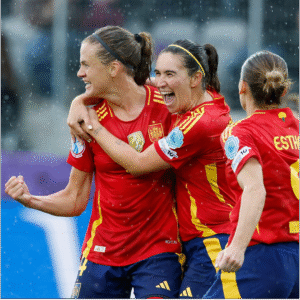
16-year-old Sofia Vorobei asks why women’s football doesn’t get the attention it deserves, as Women’s Euro 2025 kicks off
In Spain, football culture is huge. There hasn’t been a single day at school when I haven’t heard a conversation about it or taken part in one. Even if you’re not into the sport, you’ll still know what’s happening.
But despite all the football talk around me – at school, in casual conversations, or on the news – I had no idea that Spain’s women’s national team are currently the reigning World Cup champions, having beaten England 1–0 in Sydney in 2023. Not once did I hear it mentioned (despite the furore afterwards with Luis Rubiales, then head of Spain’s football federation), until I started looking into it.
What has made this even more surprising is that girls do play football in Spain – a lot. Many of my classmates are on the town’s team and train more than four times a week, even more than some of the guys. That’s a serious commitment.
Harbingers’ Weekly Brief
Subscribe to the Harbingers’ Weekly Brief, a newsletter written by the editorial board of Harbingers’ Magazine, the world’s youngest newsroom, delivered to your inbox every Monday morning.
![author_bio]()


But here’s the strange part: even those girls, who live and breathe football, mostly look up to male players. When I asked around, hardly anyone could name a single professional female footballer. How can you be so dedicated to a sport and know nothing about its top women?
It may be surprising, but it is also understandable. Men’s football is everywhere: in the headlines, on TV, on social media. Meanwhile, women’s wins – even a World Cup – barely make a splash. People talk more about second-tier men’s leagues than they do about the top women’s teams.
Then, there’s the money. The resources behind the men’s game are on another level. In 2025, the total enterprise value of the top 32 European men’s clubs reached €64.7bn.Women’s football just can’t compete with that yet – even though it’s been growing fastin the last few years.
More money means better facilities, more media coverage, more fans, and way more visibility. The attention gap is partly driven by a massive investment gap.
At the end of the day, people follow what they’re exposed to. This dynamic is not unique to sports. Can you name a male supermodel? Probably not. But you likely know the names of Adriana Lima, Kate Moss and Naomi Campbell. That’s because women dominate the modelling industry, just as men dominate football.
There’s some logic to this division. Football is a physically demanding sport, and many feel the men’s game fits traditional ideas of what makes it exciting to watch. Many still link its appeal with greater average muscle mass, explosive power and higher oxygen-carrying capacity – traits often celebrated in the men’s game that contribute to it looking more high-impact, but are, in fact, simply biological.
Meanwhile, modelling often highlights qualities like elegance and presentation, which society typically associates with women. This shapes who gets attention and why.
However, the fact that it’s always been this way doesn’t mean it’s the right way. Things evolve.
Spain at Women’s Euro 2025
With the Women’s Euro 2025 competition now in full swing, after kicking off on 2 July, women’s football stands at a turning point. Spain, nicknamed ‘La Roja’, are among the favourites to win. The team is led by Ballon d’Or winner Aitana Bonmatí and talented players such as Alexia Putellás.
Despite some early concerns, such as Bonmatí’s illness and Cata Coll’s injury, Spain delivered an impressive 5-0 victoryover Portugal, followed by a 6-2 defeatof Belgium.
Looking at other contenders, France and England are tough opponents, just as their male counterparts are. France’s attack looks dangerous, and England, despite injury setbacks, are still a serious threat as the defending champions. Germany can’t be counted out either – they’re not going to be a walk in the park for Spain.
So even if the buzz here feels low, the Euros promise high-quality football and plenty of competition – I’d hate to miss that. The matches I’ve seen so far seem pretty solid, though you can often tell which team is dominant from the start.
I may even get a few friends into it too. After all, if we want things to change, maybe it starts with people like us actually watching.
And honestly, with the Club World Cup still ongoing, LaLiga kicking off mid-August, and the Premier League, Bundesliga, Serie A and others following shortly after, I’ll already be watching football all summer. Might as well make room for the women’s game too.

© 2026 The Oxford School for the Future