


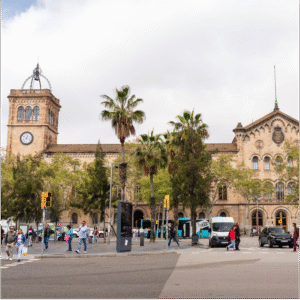
16-year-old Sofia Vorobei explains the decisions she has to make on her journey to studying journalism
Picking a university degree is no walk in the park; it’s something that will influence your whole life. “Remember, mistakes happen all the time. Feel free to drop what you are studying and start over with something new,” they say. But, frankly? Starting over is incredibly frustrating and makes you feel like you’ve lost a significant part of your time and effort – scratch that, a significant part of your life.
And in Spain, this decision comes much earlier than in many other countries. As a 16-year-old 4 ESO (Educación Secudaria Obligatoria) student, I’m already expected to begin narrowing down my future path. While no one explicitly insists, it’s clearly implied and it makes absolute sense. Here’s why.
After the compulsory four-year phase (ESO), I have three choices. I can either leave school; choose vocational training (Formación Profesional or FP) to pursue a profession that doesn’t necessarily require a university degree – like electricians or make-up artists; or continue my academic studies (Bachillerato). This is the Baccalaureate, the equivalent of 11th and 12th grade in the US or A-levels in the UK.
Harbingers’ Weekly Brief
Subscribe to the Harbingers’ Weekly Brief, a newsletter written by the editorial board of Harbingers’ Magazine, the world’s youngest newsroom, delivered to your inbox every Monday morning.
![author_bio]()
![author_bio]()


For someone like me, who wants to pursue sports journalism, the most strategic pick would be the Bachillerato. I have to select from four “modalities”: science and technology; humanities and social sciences; arts; or general, which is intended for those who are unsure of their path, though it’s usually not recommended because you’d have a mad amount of catching up to do once you decide on a degree.
In my case, I would opt for humanities and social sciences, but this is where the real challenge comes: it’s time to pick the specific subjects I want to study, and those will ultimately shape my chances of getting into university for a particular degree.
I want a degree in journalism. To do this, I need to open la tabla de ponderación for the part of Spain (“autonomous community”) I want to go to university in. The tabla de ponderación is a table that lists all the Bachillerato subjects and the number of points each subject contributes to the entry requirements for different degrees in a community (ranging from a minimum of 0 to a maximum of 0.2).
How does it work, exactly?
In Spain, getting into university is based on a combined score made up of two main parts: your average Bachillerato grade (worth 60%) and your score from the standardized university entrance exam, or PAU exam (worth 40%).
The minimum grades required to enter specific degree programmes at public universities in Spain are known as notas de corte (“cutting grades”). These vary each year depending on the demand for the course and the grades of the applicants. Each university publishes its own notas de corte after the application period.
When applying, you are advised to create a ranked list of up to 20 preferred degree programmes across different universities. If a student meets the “cutting grade” for their highest preference, they are admitted to that programme, and their lower preferences are automatically cancelled. For example, if you are admitted to your fifth choice, options 6 through 20 are no longer considered.
Public vs private schools
In Spain, public universities generally hold more prestige than the private ones, due to the notas de corte (non-existent for private institutions), higher admission standards and their long-standing history. This contrasts heavily with the US, where private universities such as the Ivy League are consistently a part of top global rankings. Though some private universities in Spain are gaining recognition as well, they have a long way to go to compete with the public institutions with their established reputation and competitive entry.
So, choosing your university path at 16 makes all the sense in the world in Spain because of how our education system is set up.
After ESO, you decide between FP or Bachillerato. If you pick the latter, you need to choose your subject focus pretty early. This choice is important because it affects what you can study at university later, especially with how your subjects are weighted in the PAU exam.
Think of it like this: the Spanish system likes you to start aiming for your goal earlier, so your last years of school actually help you get there. It’s a bit different from the US, where you usually have more wiggle room to explore in college before locking in your major. Here? It’s a bit more “plan ahead, dude!” from like, age 16.
Therefore, the system works in favour of those who know what they want from an early age, which can be seen as a way of “filtering” and only letting ambitious people get ahead.

Edited by:

© 2026 The Oxford School for the Future